Water ingress remains one of the most persistent challenges affecting modern building envelopes. Despite significant advances in façade engineering, weatherproofing membranes and construction technology, leaks continue to cause costly remedial work, disruption and long-term building performance issues.
From the United Kingdom to Europe and the Middle East, the causes of façade water ingress are often remarkably similar. While materials and construction methods vary between regions, many problems originate from the same critical locations: joints, penetrations, interfaces and areas where the weatherproofing system loses continuity.
Understanding these vulnerabilities is essential to designing and installing façade systems that deliver reliable, long-term protection.
Why Does Water Ingress Remain a Challenge in Modern Construction?
Modern façades incorporate multiple layers designed to manage water, air and moisture movement. External cladding sheds most rainfall, cavities facilitate drainage and pressure moderation, and breather membranes provide a secondary weather-resisting layer. [3]
However, even when individual components perform as intended, the building envelope can remain vulnerable if the connections between them are not correctly designed and sealed.
The scale of the wider construction defects challenge is illustrated by data from the National House Building Council (NHBC). Its 2018/19 Annual Report recorded more than one million site inspections, during which 446,071 issues requiring correction were identified. During the same reporting period, NHBC paid £85.6 million in claims. [1]
Although these figures relate to construction defects more broadly and are not specific to façade leakage, they demonstrate the importance of construction quality, early intervention and effective technical coordination.
The challenge is therefore not simply selecting high-performance materials. It is ensuring that they work together as a continuous, properly installed system.
Where Do Modern Façades Commonly Leak?
One of the most challenging aspects of investigating façade leaks is identifying the original point of water entry. Water can travel behind cladding, along structural elements, through cavities and across poorly sealed connections before becoming visible inside a building. A damp internal wall or stained ceiling may therefore indicate water ingress originating several metres away.
While every building requires an individual assessment, particular attention should be given to the following areas.
1. Window and Door Interfaces
Window heads, sills and perimeter connections bring together several construction components within a relatively confined space. Waterproofing membranes, cavity barriers, masonry supports and restraint systems must often be integrated around the same opening.
Where these elements have not been properly coordinated, gaps or discontinuities can develop in the weather-resisting layer, creating potential paths for water ingress.
2. Façade Penetrations and Fixings
Modern façade systems rely on numerous mechanical fixings, support brackets and structural attachments. Each penetration through a breather membrane or other weather-resisting layer requires consideration to maintain the intended performance of the system.
Primary support brackets often receive particular attention during installation, with additional sealing measures used to reduce the risk of water tracking around fixing points. However, smaller penetrations created by insulation fixings, restraint systems, cavity barrier supports and secondary attachments can receive less attention.
Individually, these penetrations may appear insignificant. Across a complete façade, however, they can introduce multiple potential points of vulnerability.
3. Membrane Overlaps and Transitions
The continuity of the weatherproofing system depends on properly designed and sealed membrane overlaps, joints and transitions. Poor adhesion, incompatible materials, inadequate substrate preparation or incorrect installation can compromise these connections.
Movement between building components and exposure to changing temperatures can place additional demands on sealing details. Selecting compatible membranes, tapes and accessories is therefore essential to achieving reliable performance throughout the building’s service life.
4. Connections Between Different Façade Systems
Particularly complex details arise where several systems converge, such as:
- Façade-to-roof connections
- Curtain wall interfaces
- Slab edges and parapets
- Service penetrations
- Cavity barrier and structural support interfaces
Each component may satisfy its individual performance requirements, while the combined detail remains vulnerable if continuity has not been addressed. These interfaces require careful design coordination and a clear installation sequence.
Does the Position of the Breather Membrane Affect Façade Performance?
The position of the breather membrane within the wall build-up is another important consideration. In many façade constructions, the breather membrane is installed directly over the sheathing board, behind the insulation layer.
This arrangement can be suitable when appropriately designed. However, subsequent installation of insulation fixings, support systems and other components may create multiple penetrations through the weather-resisting layer. Once concealed behind additional construction layers, these penetrations can become difficult to inspect or seal.
An alternative approach adopted in some façade systems involves positioning the weather-resisting membrane further towards the exterior of the wall build-up, protecting the insulation and potentially making sealing details more accessible during construction.
This arrangement can offer advantages in particular applications, but there is no universal solution. Fire performance requirements, cavity design, structural considerations, moisture management, material compatibility and installation sequencing must all be assessed before selecting the most appropriate membrane position.
The objective is not simply to position the membrane differently, but to ensure that the complete façade system effectively manages water and moisture throughout its service life.
Why Is Continuity More Important Than Individual Product Performance?
A high-performance weatherproofing membrane cannot, by itself, guarantee a watertight building envelope. Its effectiveness depends on how it is connected to adjacent materials and how penetrations, interfaces and transitions are treated.
This is why façade waterproofing should be considered as a complete system rather than a collection of individual products. A successful system requires:
- Compatible membranes, tapes, adhesives and accessories.
- Carefully designed sealing details around openings and penetrations.
- Appropriate consideration of structural movement and substrate conditions.
- Effective drainage and moisture management.
- Correct installation sequencing and workmanship.
- Inspection and quality control before critical details are concealed.
When these elements are coordinated from the earliest design stages, the risk of water ingress can be reduced and installation becomes easier to manage.
How Can Effisus Support Façade Weatherproofing Continuity?
At Effisus, we approach weatherproofing as a complete system, combining high-performance membranes, compatible sealing accessories and expert technical support. Our solutions are designed to help architects, façade consultants and contractors address the critical details that determine building envelope performance.
Depending on the application and project requirements, solutions may include:
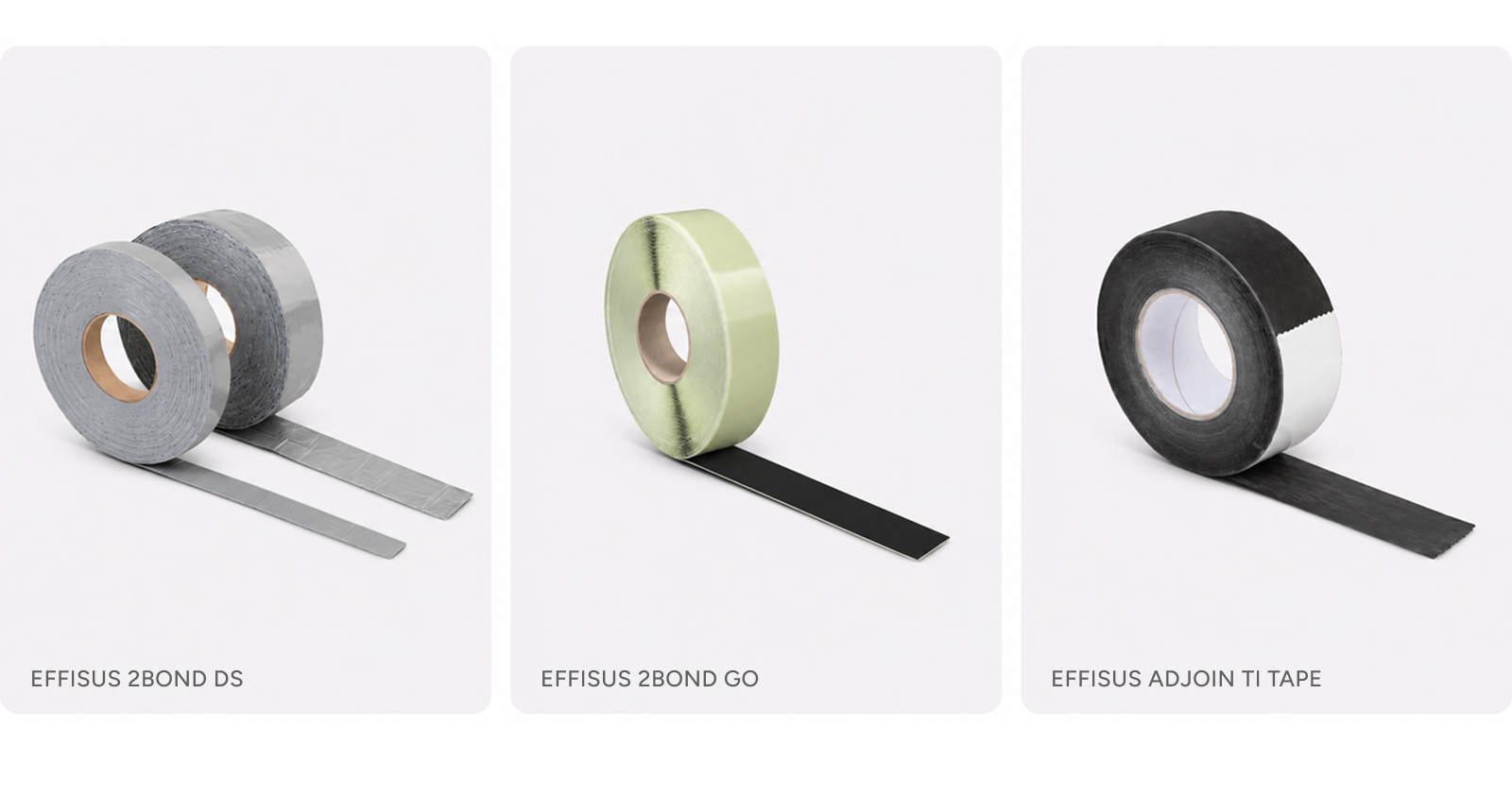
Effisus 2Bond DS
A flexible, double-sided sealing solution designed for connections between compatible surfaces and sealing around certain mechanical fixing penetrations. It can help maintain the integrity of weatherproofing details where nails, screws and other fixings penetrate the intended sealing layer.
Effisus 2Bond GO
A versatile double-sided sealing tape designed to support reliable connections between compatible construction materials, including applications involving façade interfaces and membrane connections.
Effisus Adjoin TI Tape
A flexible adhesive tape developed for sealing membrane overlaps, joints and selected connections involving breather membranes and vapour control layers. It helps maintain airtightness and weatherproofing continuity across compatible substrates.
These solutions are intended to complement properly designed façade assemblies, not replace appropriate detailing, drainage provision or correct installation practices. Their suitability must be assessed according to the relevant substrates, expected movement, exposure conditions and overall system requirements.
The Importance of Early Technical Coordination
Many façade waterproofing problems can be traced back to decisions made long before installation begins. Drawings may identify the necessary membranes, support brackets, cavity barriers and fixing systems without fully resolving how these components should connect.
When these details are left unresolved, responsibility often shifts to site teams, who must find practical solutions after procurement and construction methods have already been established.
Early collaboration between architects, façade consultants, contractors and weatherproofing specialists can help identify these risks before they become costly problems.
At Effisus, our technical teams support projects through product selection, compatibility assessments, detailing and installation guidance, helping ensure that weatherproofing solutions are considered as part of the complete building envelope.
This approach supports more efficient installation, improved coordination and greater confidence in long-term performance.
Is the Construction Industry Making Progress?
There are encouraging signs that greater attention to construction quality and technical risk management is having a positive impact. In its 2023/24 Annual Report, NHBC linked improved claims experience to its long-term focus on construction quality, enhanced technical risk management and improvements in builder quality control. [2]
While building defects remain an ongoing challenge, these developments reinforce the importance of identifying potential problems early and improving coordination between the different elements of a building.
For façade weatherproofing, this means giving greater consideration to membrane continuity, penetrations and critical interfaces before construction begins.
Looking Beyond the Membrane: The Future of Façade Waterproofing
Modern weatherproofing materials can deliver increasingly sophisticated performance. However, the long-term success of a façade depends on much more than the technical properties of individual products.
The most vulnerable areas are often the smallest: a fixing penetration, a membrane overlap, a window interface or a connection between different building systems.
Preventing façade water ingress requires a coordinated approach that considers the complete building envelope, from initial design and product selection through to installation and inspection.
By prioritising continuity, compatibility and early technical collaboration, project teams can reduce weatherproofing risks and help ensure that modern façades perform as intended throughout their service life.
Make Weatherproofing Certain with Effisus
Effisus combines proven weatherproofing solutions with expert technical support to help architects, consultants and contractors address complex façade detailing challenges.
From design review and product selection to installation guidance, our specialists help project teams develop reliable, project-specific weatherproofing systems.
Talk to our experts to discuss your next project.
Frequently Asked Questions
What are the most common causes of façade water ingress?
Common causes include poorly sealed membrane overlaps, penetrations through weather-resisting layers, inadequately detailed window interfaces and discontinuities where different façade systems connect.
Can a high-performance breather membrane prevent façade leaks?
A high-performance breather membrane can form an effective secondary weather-resisting layer, but its performance depends on compatible accessories, continuous detailing, suitable drainage and correct installation.
How can façade water ingress be prevented?
Risk can be reduced through early technical coordination, careful detailing of joints and penetrations, compatible weatherproofing products, appropriate installation sequencing and inspection before concealed areas are closed.
References and sources
The sources below support the industry statistics and technical guidance in this article.
[1] NHBC — Annual Report & Accounts 2018/19 — Source for the 2018/19 inspection, defect correction and claims figures; not façade-specific.
[2] NHBC — Annual Report & Accounts 2023/24 — Supports discussion of improving claims experience and long-term construction quality initiatives.
[3] CWCT — Specification and Standard for Systemised Building Envelopes — Technical background on weather resistance, façade interfaces, moisture performance and system specification.